Outdoor Greek theatre is:
- Public Speaking
- Theatre of the Mind
- Declamatory Speech.
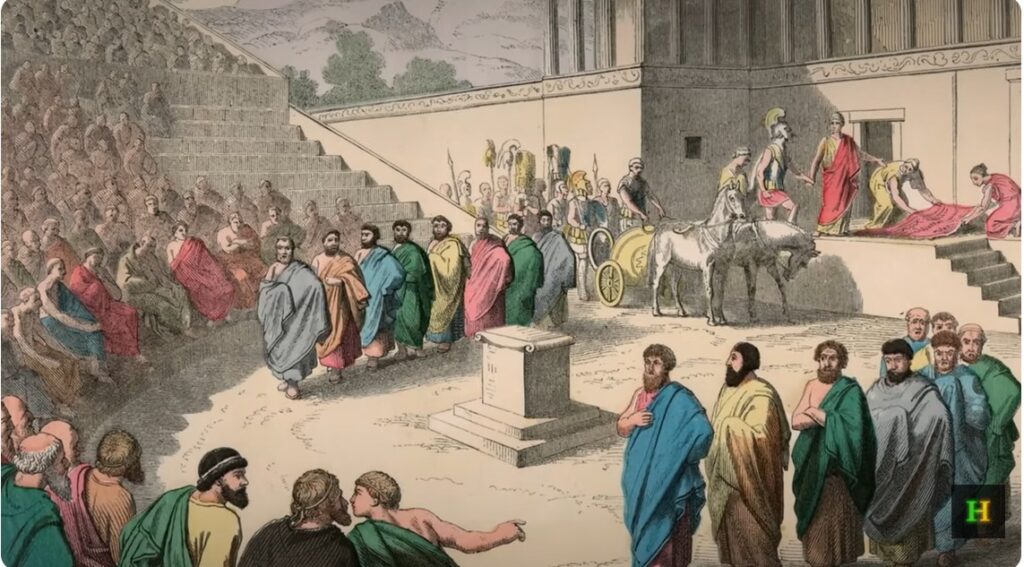
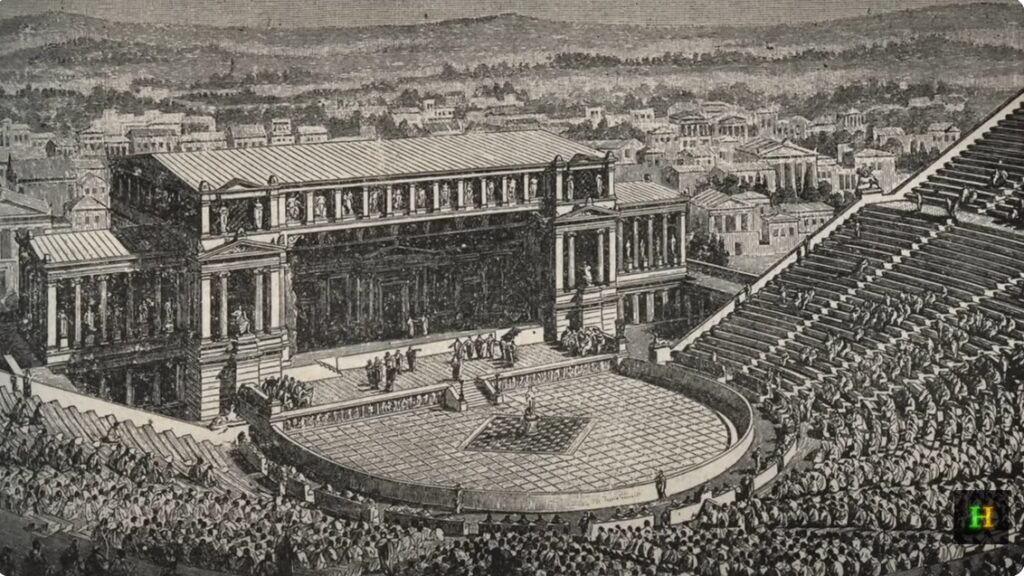
In Ancient Greece, these were not just stylistic choices, they were technical necessities. They enabled 15,000 people at the Theatre of Dionysus, on the southern slopes of the Acropolis, to hear every word, see every gesture and ride the emotional highs and lows of the stories. For the audience, it was visceral. They felt part of the action, part of the event.
Public Speaking – using the voice, body (gesture) and mind.
- From around 500 BC, during the birth of democracy, the line between actor and politician in Athens was incredibly thin. They often ‘performed’ in the same spaces, most notably the Theatre of Dionysus. The amphitheatre served as a central hub for religious, cultural and political gatherings. The actors and politicians used the same rhetorical tools. In the plays, the characters often spoke in formal debates, putting their respective cases to the audience (the public). The plays were highly influential during the birth of democracy, exploring the role of the individual and the role of the collective. The theatrical and political spheres in Athens were deeply integrated, using the same central public arenas to communicate with the citizenry.
Theatre of the Mind – Because Greek theatre uses minimal sets and props, the spectacle happens largely in the audience’s imagination. The actors, using visualization techniques, use their words, voice, gesture and imagination to paint pictures in the minds of audience members. If the actor can see it in his mind, the audience is there as well. There is almost no direct violence shown on stage. Horrific acts like murders, suicides and mutilations are kept off stage, forcing the audience to imagine the horrors via vivid descriptions from messengers.
Declamatory Speech – in simple terms, loud and formal. A public address designed to persuade or stir strong emotions through forceful delivery and theatrical language and performance.
Greek theatre is mimetic (imitating human action). It is not naturalistic. It aims for stylistic grandeur – a re-interpretation, re-presentation of the world and life – rather than realistic everyday detail. The scale of the theatre required large, presentational acting (gestures and vocal projection) rather than internalized, fourth wall everyday naturalism.
The bigger the outdoor theatres get, the more important these 3 things are; public speaking, theatre of the mind and declamatory speech. It should be an event for the audience. There should be no doubt about what’s going on.
A fourth pillar is Group Synchronicity. The Chorus, representing the collective conscious, bridges the gap between the actors and the audience. – Michael J Smith