KNOW THYSELF – NOTHING IN EXCESS – CERTAINTY BRINGS RUIN
Sophocles (496-406 BC) was a singer, dancer, musician, actor and playwright in Athens. He also worked in public affairs, serving as a treasurer, and a general alongside Pericles. He was also pious, serving as a priest. He was deeply involved in bringing the worship of Asclepius, the god of medicine and healing, to Athens.
He wrote some 123 plays of which 7 have survived in their complete form, including Oedipus the King, Oedipus at Colonus, and Antigone. Antigone is probably the most famous ancient Greek play. Oedipus the King is often described as the best. “The play is universally recognized as the dramatic masterpiece of the Greek theatre,” said British-American classicist and scholar Bernard Knox (1914-2010). Aristotle (384-322 BC) famously, in his Poetics, cites Sophocles’ Oedipus the King as the supreme model of how a tragedy should be constructed to achieve maximum effect. Both plays, Antigone and Oedipus the King, were famous and much loved during Sophocles’ lifetime. 2500 years later they are still very much with us.
The ancient Greek plays were highly influential during the birth of democracy in Athens in the 5th century BC, exploring the role of the individual and the role of the collective. They are as relevant today as they were 2500 years ago. Greek Theatre Now is pleased to present Oedipus the King to Canberra audiences this April 2026 – Michael J Smith.
Story
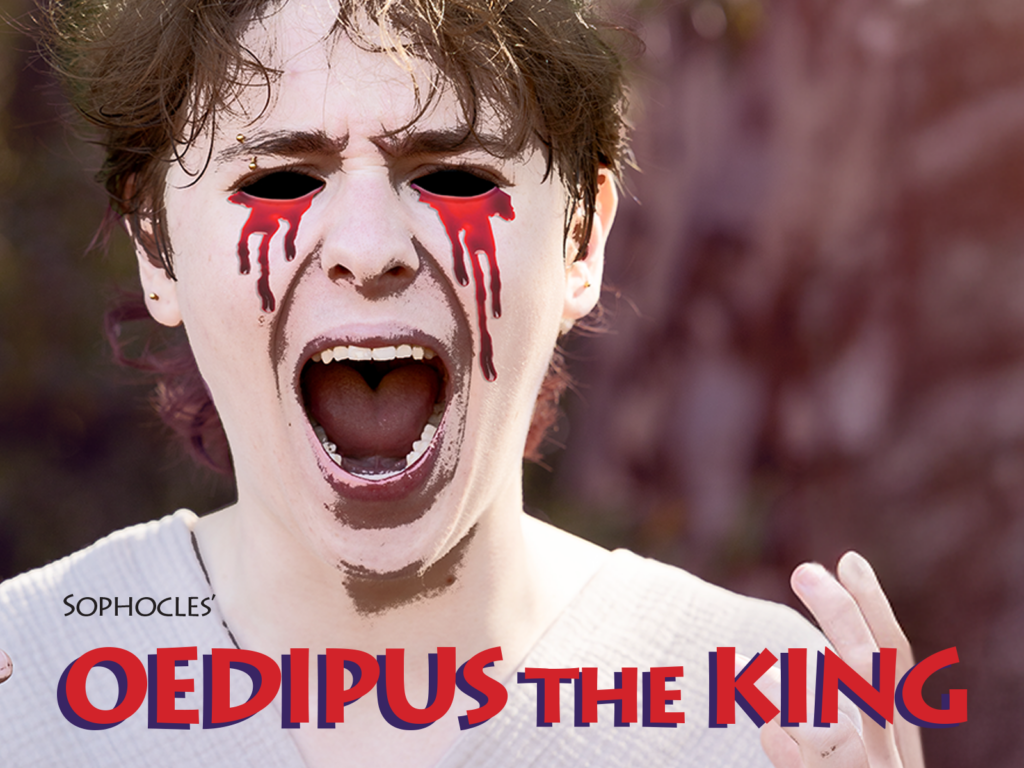
Oedipus is the king of a city, Thebes, ravaged by a mysterious plague. He consults Apollo, the god of prophecy, truth and healing, at Delphi and is told that the plague will end only when those who killed the previous king, Laius, are found and punished. He launches an investigation, in the course of which he discovers not only that he himself is the killer but that Laius was his father and Laius’s widow, whom he married, his own mother. As a result of this revelation Oedipus changes from being a respected king and conscientious investigator into a polluted and self-blinded outcast.
Characters
Oedipus, King of Thebes, Priest of Zeus, Creon, Oedipus’s brother-in-law, Jocasta, wife of Oedipus, sister of Creon, Teiresias, an old blind prophet, Chorus, citizens of Thebes, Corinth Messenger, Theban Shepherd, Palace Messenger, Guard, Antigone & Ismene, young daughters of Oedipus and Jocasta.
Three-Actor Rule
In ancient times, Greek theatre, it’s believed, began with the Dithyramb, a frantic, ecstatic hymn sung in honour of Dionysus, the god of wine, divine possession, religious ecstasy and fertility.
A group of up to 50 men and/or boys would dance in a circular space while chanting or singing. It was highly ritualistic.
Around 534 BC, a Greek poet named Thespis stepped out of the Chorus. Instead of singing about a god or hero, he started to impersonate them. And he engaged in dialogue with a Chorus leader. This started a ‘call and response’ between an individual and the collective.
The great tragedian playwright Aeschylus (525-456 BC) added a second actor, allowing for conflict between two individuals.
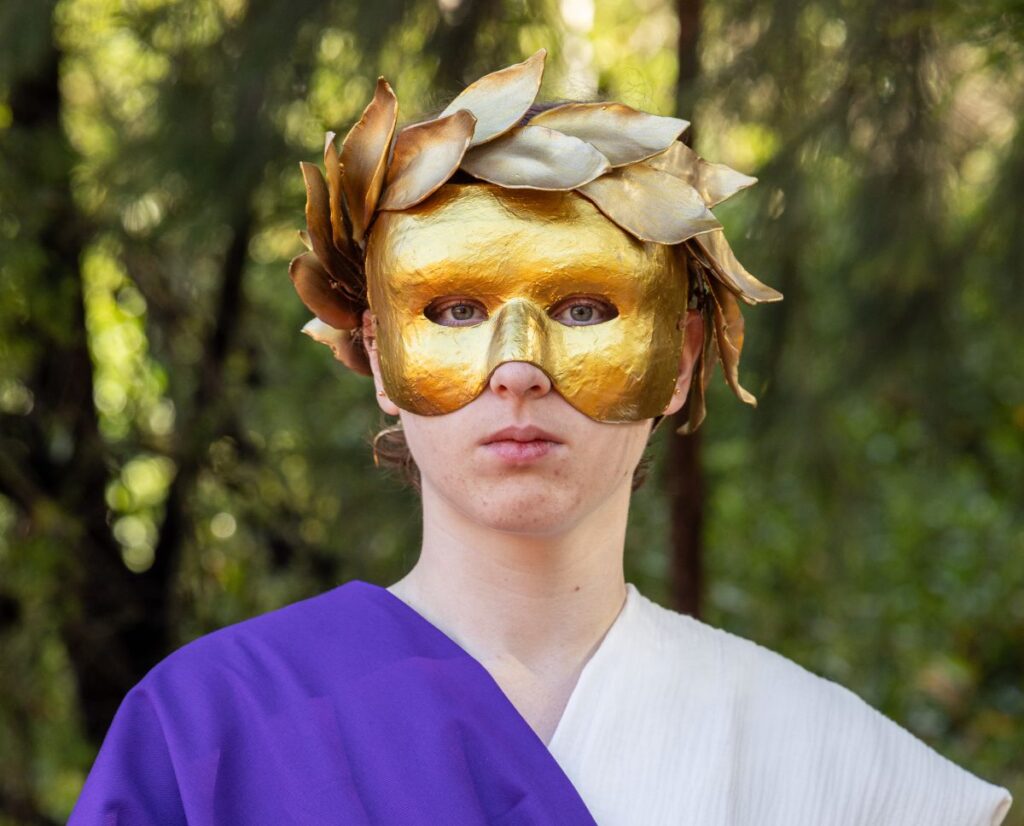
Sophocles added a third actor, creating complex social dynamics. There are no more than three individual speaking actors on stage at any one time. All roles were played by 3 professional actors. They changed masks and costumes to play different characters. The Chorus was made up of everyday citizens of Athens, amateur performers. They took months off from their day jobs, as blacksmiths, farmers or merchants, to rehearse. Being a Chorus member was an important civic duty, a bit like jury duty. Using regular citizens for the Chorus was a deliberate political and social choice. The Chorus represented the ‘common voice’. Using everyday citizens reinforced the idea that the drama was about the entire community, not just the legendary heroes on stage. The Chorus bridges the gap between the declamatory style of the individual performers and the audience.
Cast & Crew
Featuring Andrew Mackenzie as Oedipus, Owen Maycock as Creon, Kate Blackhurst as Jocasta and George Belibassakis, Roslyn Hull, Liam O’Connor, Louisa O’Brien, Jade Boyle and Marcus Mele.
Masks and Props by Ben Smith Whatley. Photographer Fuyao Liu. Graphic Designer Emilio Park. Costume Designer Bhanupriya Pandya. Classics Adviser Elizabeth Minchin. Producer/Director/Writer Michael J Smith.
Contemporary English translation. Run time 100 mins. Buy Tickets.